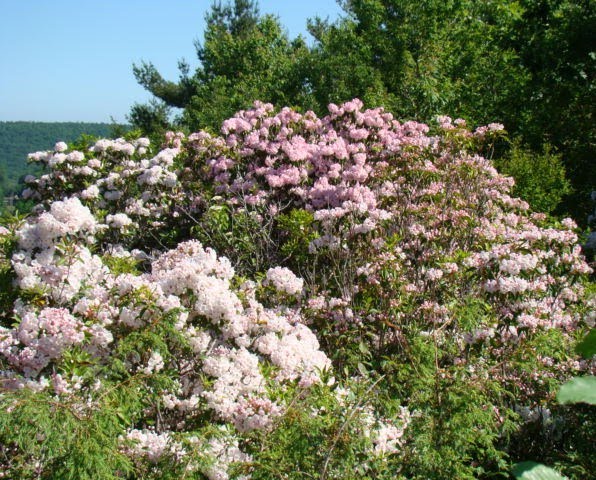
As part of the University of Connecticut Cooperative Extension System Master Gardener Program, interns must complete the Tree, Vine and Shrub Identification Project. The project entails the creation of an ID notebook consisting of trees, vines and shrubs that are common to Connecticut. The purpose of the project is to learn about different plant characteristics, structures, growing conditions, and problems of the most commonly grown garden ornamental plants, as well as the principle invasive plants which pose a major problem in our state.

Categories

Showing posts with label Vines. Show all posts

FAMILY: Hydrangeaceae

Hydrangea anomala petiolaris (Climbing Hydrangea)


General Information

Climbing Hydrangea is a slow-growing, deciduous climbing vine with graceful lateral branches and dense, heart-shaped leaves. It is native to Japan and was introduced to North American in the mid 19th Century. It is not particularly tolerant of heat and humidity in the southeast and does best in zones 4 to 8 (9-10 in the west).

Plant Habit and Form

The main stems of Climbing Hydrangea climb vertically, as much as 30 feet, with horizontal side branching giving it a three-dimensional effect. If there is no structure to climb, the vine grows as a mounded 3- to 4-foot shrub. The bark on mature branches is an attractive, exfoliating reddish brown.

Growing Requirements

Climbing Hydrangea requires cool, moist, well-drained soil that’s rich in organic matter. It does not do well under hot, dry conditions. It prefers sun to partial sun and requires shade in the warmest limits of its range (zone 8 in the southeast and 9 to 10 in the west). Climbing Hydrangea is slow to get started but vigorous once it gets established.

Flowering and Fruiting

Climbing Hydrangea blooms in late spring to early summer with flattened clusters of white, fragrant lacecap flowers, about 6 to 10 inches wide -- smaller flowers in the center surrounded by a ring of showier flowers. Brown capsules follow flowering that persist in flat plane into the following season.

Pests and Diseases

Relatively free of pests except for occasional bouts with aphids.

ID Tips

Central main stems with lateral horizontal branches. Climbs by aerial rootlets. Heart-shaped, glossy dark green, dense leaves.

FAMILY: Anacardiaceae

Toxicodendron radicans (Poison Ivy)


General Information

Poison Ivy is a dominant understory plant occurring under, but not limited to, varieties of oak, pine and hickory trees. It is native to North American and can be found across eastern Canada extending south through the U.S. to Florida and Texas. It is hardy in zones 3 to 10.

This deciduous vine’s sap causes allergic dermatitis in humans. Animals seem to be unaffected by the sap.

Plant Habit and Form

The leaves of Poison Ivy are pinnately compound with 3 irregularly toothed, shiny green leaflets measuring 2 to 4 inches long, the total length of the leaves being 7 to 10 inches. Leaves emerge red in spring and a bright red and orange in fall.

Poison Ivy may be low-growing, climbing, or take on a bush form. It clings to surfaces with hair-like aerial rootlets growing out of the stem.

Growing Requirements

Poison Ivy climbs toward the sun but thrives in shade as well. It is not a particular plant and enjoys areas with short, hot summers and cold to cool winters. It lives in a wide variety of soil conditions from poorly draining clay sites to sandy, well-drained sites.

Flowering and Fruiting

The greenish white flowers of Poison Ivy are small and followed by clusters of greenish white, round 1/4-inch in late spring and early summer. The berries are enjoyed by many bird species.

Pests and Diseases

None found.

ID Tips

Leaves of 3, let it be. Shiny green on above surface, paler below. Climbing or creeping vine or bush.

FAMILY: Vitaceae

Parthenocissus quinquefolia (Virginia Creeper)


General Information

Virginia Creeper is a fast growing, woody deciduous vine native to North America. The vine climbs or creeps by means of tendrils that fasten onto rocks, walls or bark. The 4- to 8-inch leaves are palmate with five leaflets coming out of a central leaf stem. They provide bright fall color in tones of red and purple. It is easy to grow and established plants can be somewhat aggressive, reseeding itself and sending up sprouts everywhere.

Virginia Creeper is native from eastern North America south to Florida and west to Texas, extending north through the central states to Saskatchewan and Manitoba. It is hardy in zones 3 to 9.

Plant Habit and Form

Virginia Creeper can grow to 40 feet in length depending on the structure supporting it. Small disks are located on the tendrils that attach to the climbing surface. When allowed to creep along the ground, it sends out adventitious roots.

Growing Requirements

Virginia Creeper grows in full sun nd partial shade. It thrives in moist soil where it will be happy without climbing anything, yet is drought tolerant.

Flowering and Fruiting

The greenish pink flowers of Virginia Creeper are small and arranged in clusters. They are followed by bluish green 1/4-inch fruit that mature to dark blue-black, and are favored by birds and other wildlife.

Pests and Diseases

Mildew, leaf spots and cankers can be somewhat problematic for Virginia Creeper but it is generally trouble-free.

ID Tips

Alternate, palmate leaves with 5 elliptical leaflets per leaf. Blue-black 1/4-inch berries. Climbing or creeping vine.